
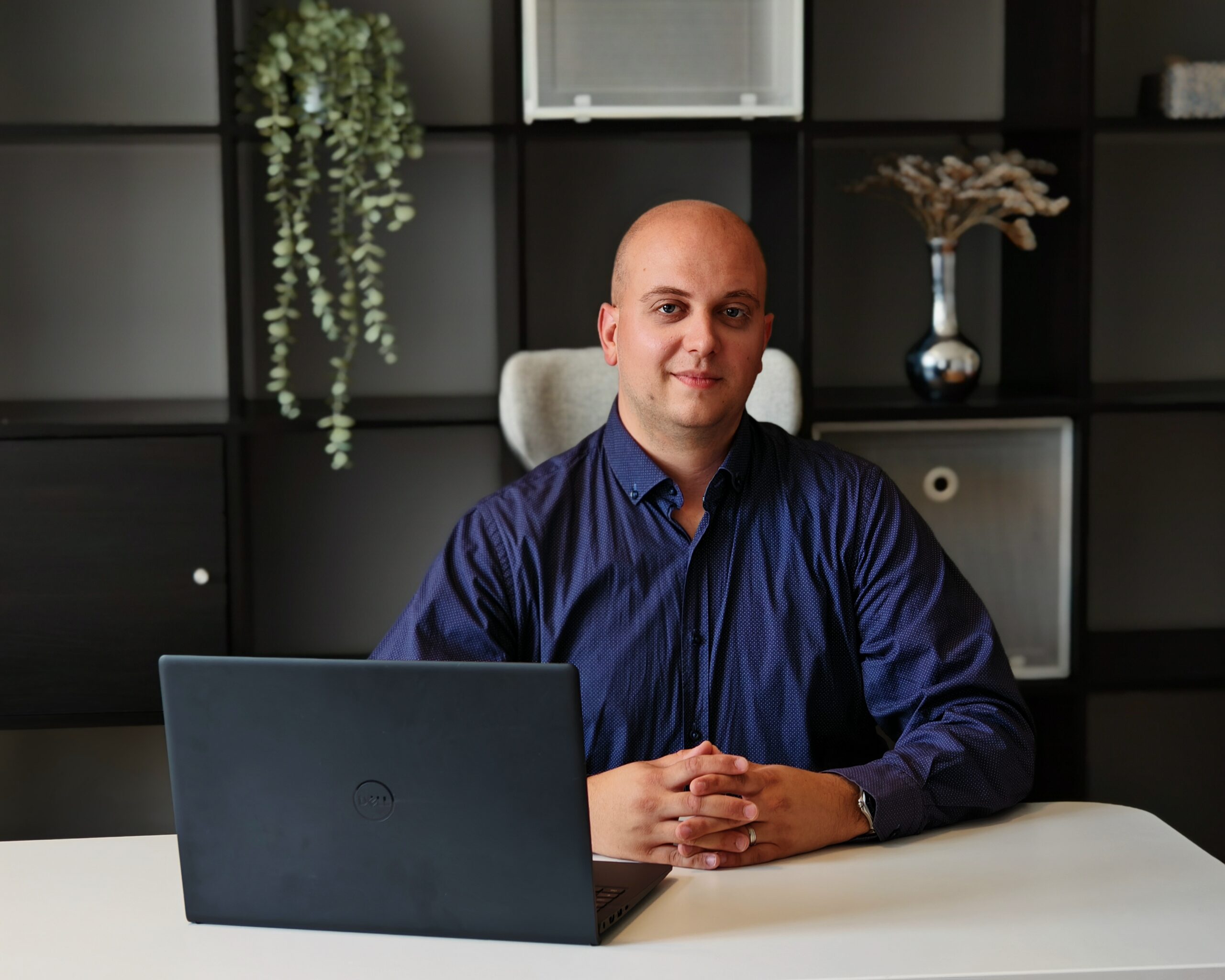
Dinko Đurđević, PhD, MBA: Founder and Director of Green Sustainable Solutions d.o.o.
Interview conducted by:
Lidija Zelić
Serbian Biogas Association
I place great value on regional cooperation, particularly as a way to share knowledge, connect with professionals facing similar challenges and turn shared ideas into concrete initiatives. In conversations with colleagues from neighbouring countries, I often recognise dilemmas I am trying to resolve myself, while their experiences help me see those issues in a different light. Our markets are small and fragmented, and many of our challenges are shared. That is why I believe the knowledge we gain becomes far more valuable when we share it and use it to create new opportunities across the region.
I particularly value encounters where there is an openness to discuss both successes and things that have not gone as planned. These conversations help us understand one another better, build trust and identify where we could join forces. For me, this is where lasting cooperation begins.
My conversation with Dinko Đurđević, PhD, MBA, founder and director of Green Sustainable Solutions d.o.o., was one such encounter. His international experience and the way he connects energy, the circular economy and the bioeconomy encouraged me to take a broader view of the topics I work on every day.
We discussed biogas, biomethane and hydrogen, waste as a resource, and lessons from Croatia that could be useful for Serbia. Throughout our conversation, we also explored what we could achieve together. I particularly share his view that regional cooperation should be driven by genuine common interests, some of which we identified during our discussion. I would like us to make more room for these opportunities, learn from one another and turn such encounters into projects that bring tangible benefits to the communities in which we work.
Dinko, how has your career evolved since your early days at the Hrvoje Požar Energy Institute, and what inspired you to focus on renewable energy?
I began my career after completing my studies in environmental engineering, where the emphasis was on applying engineering principles to environmental protection. I had always been interested in energy and gained my first significant professional experience at the Hrvoje Požar Energy Institute. There, I worked on renewable energy projects that linked technical solutions with energy policy and broader European development priorities.
Early on, I realised that the energy transition cannot be understood solely in terms of individual technologies. Building more solar or wind farms is not enough; we also need to understand how the energy they generate will be integrated into the system, who will use it, and how it will affect the economy and end users. It was this need to bring together the technical, economic and environmental dimensions that drew me to the field.
Later, through my work at Hydrogen Europe, I focused more closely on hydrogen, particularly its use in mobility and the development of European projects in this area. Alongside this, I worked on the circular economy, energy recovery from waste, battery systems, battery recycling and reuse, and the bioeconomy. The connections between these areas also shaped my doctoral research, which focused on recovering energy and materials from waste streams and assessing different technologies in real-world local contexts.
Today, through Green Sustainable Solutions, I aim to bring these areas together. I believe future energy systems will be integrated and decentralised, combining local generation, storage, smart management and more efficient use of local resources. Looking back over my career, the common thread has remained the same: how to make an individual technology part of a sustainable system that works.
“Early on, I realised that the energy transition cannot be understood solely in terms of individual technologies; we need to understand how the energy will be integrated into the system, who will use it, and how it will affect the economy and end users.”
After working in Croatia, you continued your career at Hydrogen Europe. What were your main areas of focus there, and how did that experience help you develop as a renewable energy expert?
Working at Hydrogen Europe was an important stage in my professional development because it gave me a broader European perspective on the energy transition. My work focused primarily on hydrogen applications, particularly in mobility, as well as on developing the wider hydrogen ecosystem through major European projects and initiatives.
There, I gained an even clearer understanding that emerging energy technologies cannot be viewed solely from a technical perspective. You can have a high-quality electrolyser and produce renewable hydrogen, but without end users, infrastructure, sufficient renewable energy and a viable business model, the entire value chain will struggle to function. That experience had a lasting influence on my approach to projects: technology matters, but understanding where it fits and what specific problem it solves is just as important.
Hydrogen valleys are a good example of this approach, bringing together hydrogen production and use within a defined geographical area to serve industry, transport and other end users. Above all, my work at Hydrogen Europe helped me move from thinking about individual technologies to considering systems as a whole. It also gave me valuable insight into how major European projects and international partnerships are conceived, structured and developed.
“Technology matters, but understanding where it fits and what specific problem it solves is just as important.”
Founding Green Sustainable Solutions marked a new chapter in your career. What motivated you to become an entrepreneur, and what professional ambitions did you hope to fulfil through your own company?
Founding Green Sustainable Solutions felt like a natural extension of everything I had done up to that point, although I did not start out with a fully developed long-term vision. Through my work on European projects, I kept encountering the same problem: there was a good technology, a promising idea or a genuine need on the ground, but no one to bring these elements together into a workable project and secure the right partners and funding.
That was where I saw an opportunity for my own company. My motivation was not just greater independence and the chance to build something of my own. It was also the freedom to choose the areas I wanted to work in and to connect energy, the circular economy, the bioeconomy, mobility and new technologies. Being able to work with partners from the initial idea stage, rather than joining only once a project had been largely defined, was also important to me.
From the outset, I wanted GSS to be more than a conventional consultancy that simply writes funding applications. Our ambition is to be involved throughout the process: from developing the idea and building the consortium to securing funding, managing the project and considering how its outcomes can be put into practice and built upon after the project ends. Turning an initial idea into a tangible international project is one of the aspects of entrepreneurship I find most motivating, especially when it creates something that lasts beyond the funding period.
“Founding Green Sustainable Solutions felt like a natural extension of everything I had done up to that point.”
Which project or professional achievement stands out as particularly significant in your career? What was your personal contribution, and why are you especially proud of the outcome?
One project I would certainly highlight is DanuP2Gas. It was something of a turning point for me, drawing me further into hydrogen while also encouraging a broader, more holistic view of energy systems.
I was particularly interested in connecting different energy flows and technologies. Hydrogen was not considered in isolation, but alongside biomass, biogas and the potential to produce and use biomethane. This showed me early on that the future of energy would probably lie in intelligently connecting technologies, rather than relying on any single one, and in using each local resource where it delivers the greatest value.
The project was also personally important because it prompted me to make much stronger connections between technical areas I had previously tended to consider separately. I see that broader perspective as one of its most important outcomes: the project not only deepened my knowledge of hydrogen, but also significantly shaped the way I approach energy project development today.
DanuP2Gas broadened my understanding of the energy transition and encouraged me to think about how local resources could become parts of the same system. Afterwards, hydrogen became one of my main professional interests, eventually leading me to Hydrogen Europe. That is why I see it as a project that had a decisive influence on the direction of my career.
“The future of energy will probably not lie in a single technology, but in intelligently connecting technologies and using each local resource where it delivers the greatest value.”
Which project initiatives are currently taking up most of your attention, and what do you find particularly interesting about them, whether in terms of new technologies, partnerships or the problems you are trying to solve?
At the moment, I am mainly focused on projects that connect energy, the circular economy, the bioeconomy and sustainable mobility. These cover everything from biogas, biomethane and hydrogen to batteries and battery recycling, energy communities, system flexibility and local energy generation. What they have in common is that they can increasingly no longer be developed as entirely separate fields.
The projects I find most interesting are those that bring several technologies together into a functioning whole. A solar installation, a battery, electric vehicles and demand management can each be considered separately, for example. Together, however, they form a decentralised system that makes better use of locally generated energy and reduces pressure on the grid. A similar principle applies to bioenergy, where biogas, biomethane, biomass and hydrogen can complement one another under the right conditions.
I am particularly interested in projects that start with a real problem to solve, rather than a technology to demonstrate. That problem might be grid congestion, an unused waste stream, an industrial decarbonisation need, or what to do with batteries after their first use phase. This approach also tends to lead to stronger partnerships.
I am paying increasing attention to business models, too. Good technology is not enough without a user, a market or a financially viable way to put it into practice. That is why the projects I find most compelling are those that make technological, environmental and economic sense.
“Good technology is not enough without a user, a market or a financially viable way to put it into practice.”
You work on various ways of using waste as a resource, which was also the subject of your doctoral research. What led you to choose this topic, and how could your findings help improve current waste management practices?
My doctoral research grew naturally out of the fields I was working in: energy, waste management, the bioeconomy and the circular economy. I wanted to understand how to choose the best solution when several technologies can treat the same waste stream, each with its own technical, economic and environmental advantages and drawbacks. In practice, decisions rarely depend on a single criterion, and I found that complexity particularly interesting.
I therefore developed a model for selecting technologies to sustainably use waste biomass and wastewater for energy and material recovery. The model considers technological, socioeconomic and environmental criteria together, adapting them to specific local conditions. The aim was not simply to develop an academic tool, but an approach that could support real investment decisions.
This matters to me because the circular economy should not be reduced to the simple message that waste needs to be reused. The questions are how to use it, which technology to choose, at what cost, and with what overall impact on the environment and the local community. A solution that works well in one location may not be the best option elsewhere.
Another area I explored was phosphorus recovery from sewage sludge. It is a good example of the circular economy: a resource essential to agriculture ends up in a waste stream, yet can be recovered and returned to productive use. For me, that is the essence of the circular economy, not simply finding a way to manage waste, but recognising the resources already present in the system and recovering them in an economically and environmentally sound way.
“For me, that is the essence of the circular economy – not simply finding a way to manage waste, but recognising the resources already present in the system and recovering them in an economically and environmentally sound way.”
Biogas brings together several of your fields of expertise: energy, waste management and the bioeconomy. Which of its benefits do you think are still insufficiently recognised or realised in our region?
I find biogas particularly interesting because it brings together energy, waste management, agriculture and the bioeconomy. I think its greatest untapped potential lies in the fact that it is still too often seen simply as a fuel for electricity generation, when its real value is much broader.
A well-designed biogas plant can use agricultural residues and organic waste, generate electricity and heat, enable biomethane production, reduce methane emissions, and return nutrients to agriculture through digestate. If a local user for the heat or biomethane can also be found, the overall value of the system increases significantly.
The region has a strong foundation for this, thanks to its substantial agricultural and food production and widely distributed biomass resources. This creates opportunities for decentralised systems in which local feedstocks are used locally, and the energy or fuel stays close to where it is produced. Another benefit of biogas is its flexibility: output can be controlled to a greater extent than with solar or wind energy. That is why I see it as a technology that can complement those sources very effectively in certain systems.
Given your experience with hydrogen, biogas and biomethane, where do you see opportunities to combine them in concrete projects, and under what conditions would such projects make sense?
Combining hydrogen, biogas and biomethane is particularly interesting to me because I encountered these concepts through DanuP2Gas. One good example is the use of biogenic CO₂ separated during the upgrading of biogas to biomethane. This CO₂ can be combined with renewable hydrogen and converted through methanation into additional methane that can be used in existing infrastructure. This makes better use of biogenic carbon while increasing the amount of useful product.
Another option is to connect a biogas plant with local renewable electricity generation. Surplus solar or wind power can be used to produce hydrogen, while biogas or biomethane provides a more stable, controllable element of the system. These concepts can be particularly attractive in agricultural areas or industrial zones, where several different energy sources and users are located close together.
But technologies should not be combined simply because it is technically possible. The key questions are whether local feedstocks will remain available over the long term, whether there is enough renewable energy, whether there is a user for the hydrogen or biomethane produced, and whether the system as a whole is economically viable. It is also important to use existing infrastructure wherever it makes sense, rather than creating a new system simply because it is technologically interesting. Only when these conditions are met does the combination become a truly sustainable energy model.
“I think its greatest untapped potential lies in the fact that it is still too often seen simply as a fuel for electricity generation, when its real value is much broader.”
What lessons from Croatia would you highlight as useful for the further development of Serbia’s biogas and biomethane sector?
One of the main lessons from Croatia is that the long-term development of the biogas sector should not depend solely on incentives for electricity generation. That model stimulated investment and market development in the early stages, but the next step needs to be broader: using heat, developing biomethane, making better use of digestate and connecting with local users.
Serbia’s well-developed agriculture and food industry provide a very strong foundation for such projects. One advantage is that it can leapfrog some stages of development and move directly towards projects that capture value across the whole chain, rather than focusing only on electricity generation. I would particularly stress the need to build projects around locally available feedstocks and real users, avoiding unnecessary transport and dependence on a single revenue stream.
A stable regulatory framework is essential. These investments are planned over twenty years or more, so investors need clarity on the rules, grid connection, quality standards and the long-term market outlook. This is especially important for biomethane, because market development is inseparable from infrastructure and the opportunities to use it in industry and transport. This is where I see the potential for a new generation of more decentralised projects with stronger links to local economies.
“One of the main lessons from Croatia is that the long-term development of the biogas sector should not depend solely on incentives for electricity generation.”
If you could launch one project bringing together countries across the region, what would it look like, and where do you see the greatest scope for regional cooperation?
If I could launch one regional project, I would focus on a network of decentralised energy and resource hubs bringing together energy, the bioeconomy and the circular economy. I would not develop the same solution for every country. Each location would use the resources available locally and adopt the approach that makes the most sense for its circumstances.
Some sites would focus on biogas and agricultural residues, others on biomethane and the food industry, resource recovery from wastewater, or combining renewable electricity, hydrogen and biogenic CO₂. The shared value would lie in developing these different local solutions using a common methodology, comparing them and then transferring them to other countries and regions. Each demonstration site would address a local problem while generating knowledge that benefits the whole region.
Developing business and financing models would also be an important part of the project. Most of the technologies already exist; the harder task is to establish the conditions under which they can operate over the long term without continuing dependence on project funding. Alongside the technical pilots, we would therefore need to develop investment models and regulatory recommendations.
Countries across the region face similar challenges, but they also have similar resources, as well as skilled professionals, capable companies and strong university expertise. I would like regional cooperation to be driven more by genuine shared interests and less by the need to include partners from several countries simply because a funding call requires it. If a project demonstrates that local resources can be turned into energy, fuel or new products in an economically viable way, and that those solutions can then be replicated elsewhere, it has far greater value than a project that ends with a report.
“Countries across the region face similar challenges, but they also have similar resources, as well as skilled professionals, capable companies and strong university expertise. I would like regional cooperation to be driven more by genuine shared interests and less by the need to include partners from several countries simply because a funding call requires it.”


