
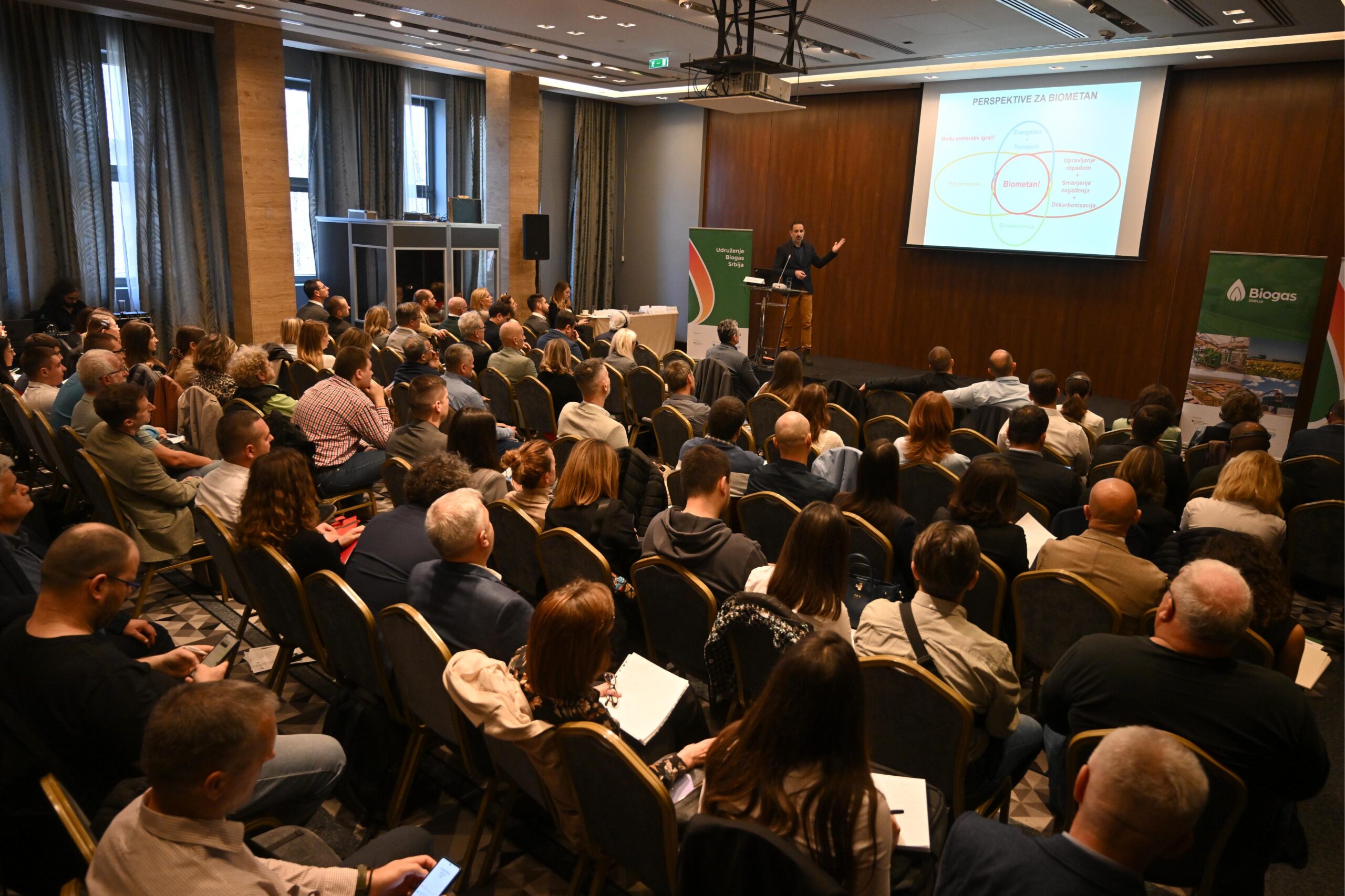
The panel conference titled “Biogas and Biomethane in Serbia by 2030 – Energy from Waste for Sustainable Development” was held on March 13, 2025, organized by the Serbian Biogas Association in cooperation with the German Biogas Association – Fachverband Biogas e.V., and with the support of the German Federal Ministry for Economic Cooperation and Development (BMZ).
The Serbian Biogas Association, as the national umbrella organization for biogas in the Republic of Serbia, is currently implementing its second major partnership project with Fachverband Biogas, aimed at strengthening and stabilizing the biogas sector in Serbia.
The primary goal of this year’s conference was to foster dialogue and exchange views on the current and future role of biogas and biomethane in Serbia’s energy transition. Particular emphasis was placed on the need to establish a legal framework enabling the use of biomethane on the domestic market and its injection into the national gas grid.
In addition to regulatory topics, the conference also addressed environmental aspects of biogas—its role in reducing greenhouse gas emissions, waste treatment, and improving soil quality through the use of digestate. Discussions also included circular economy principles, decarbonization, and the importance of biogas in achieving sustainable development goals.
Thanks to the exchange of experiences between domestic and international experts, the conference contributed to a better understanding of the sector’s potential and to identifying key steps for improving public policies, investment conditions, and technological solutions for a stable and sustainable development of biogas and biomethane in Serbia.
In the past four years, Serbia’s biogas sector has faced numerous challenges, but also growing recognition of its broader societal role. Biogas plants are no longer seen solely as electricity producers – they are now recognized as pillars of ecological sustainability and key actors in environmental protection, waste management, and the circular economy.
Nevertheless, despite biogas’ importance in Serbia’s decarbonization and energy transition, the regulation adopted in March 2021 has still not been followed by the necessary by-laws, which prevents the implementation of auction models in practice. Moreover, there is still no legal framework for injecting biomethane into the gas distribution network or for its trade, hindering the realization of this energy source’s full potential.
In this context, the support of relevant institutions – especially the Ministry of Mining and Energy – remains crucial. Only through open dialogue, intersectoral cooperation, and clearly defined legal frameworks can the conditions for further growth and stability of the sector be ensured.
The biogas sector in Serbia stands at a crossroads.Will we follow European ecological trends, as Germany has done, recognizing biogas and biomethane as tools for energy independence and environmental protection – or will we miss another opportunity for growth, competitiveness, and ecological progress?
Biomethane, as a logical and necessary continuation of biogas sector development, was the central focus of this year’s conference – both as a strategic direction and as an untapped opportunity that must be addressed in the coming months.
The conference gathered representatives of the Embassy of the Federal Republic of Germany in Serbia, the Chamber of Commerce of Serbia, experts and representatives of the Serbian Biogas Association and the German Biogas Association Fachverband Biogas e.V., as well as participants from the Ukrainian and Hungarian associations, UNDP, university professors, private sector representatives, and investors in the sector.
Thanks to the participation of national and international partners, academia, and institutions, the conference offered a comprehensive overview of the potentials, challenges, and necessary development paths for the biogas and biomethane sector in Serbia.
At the opening of the conference, Lidija Zelić, Managing Director of the Serbian Biogas Association, welcomed the participants and thanked the partners, guests, and members for their long-standing cooperation. She emphasized that the sector has grown from the first 3 MW in 2012 to 44 MW of installed capacity, with an additional 54 MW in development – a remarkable achievement for a young sector.
She highlighted that biogas and biomethane are now key parts of Serbia’s energy transition, thanks to the knowledge and commitment of all stakeholders, as well as the strong support of the German Biogas Association.
Following her speech, she announced the official opening of the conference and invited Dr. Judith Hoffmann from the German Embassy to address the audience.
Dr. Judith Hoffmann, representative of the Embassy of the Federal Republic of Germany in Serbia, officially opened the conference, further confirming the importance of the biogas topic and the strong support for bilateral cooperation in the field of green energy. In her address, she emphasized the importance of biogas development and international collaboration in achieving sustainable energy goals. Her presence and remarks reinforced the message of the need for joint action in the transition to sustainable energy sources.
She was followed by Goran Knežević, President of the Serbian Biogas Association, who emphasized that biogas is now a pillar of the green transition, thanks to the long-standing commitment and cooperation of all stakeholders. He reminded the audience that the sector did not emerge overnight, but is the result of over a decade of continuous work, education, and cooperation with investors, institutions, and international partners – especially with the German Biogas Association, whose contribution has been vital.
Following the President’s address and prior to the start of the working sessions, a ceremonial moment was dedicated to awarding special recognitions to Antje Kramer and Sabine Thaler, members of the international project team of Fachverband Biogas, for their outstanding contribution to the development of the biogas sector in Serbia, many years of dedication, generous knowledge sharing, and strong support throughout all stages of collaboration with the Serbian Biogas Association.
The working part of the conference began with the thematic session titled “From Waste to Energy – Biogas and Circular Economy in Practice.”
The first speaker was Dr. Verena Pfahler, representative of the German Biogas Association (Fachverband Biogas e.V.), who presented “Biogas & Circular Economy – From Waste to Resources,” emphasizing the role of biogas as a key component of the circular bioeconomy. She highlighted the multiple benefits of biogas – from closing the waste cycle and reducing greenhouse gas emissions, to energy production and soil improvement through the use of digestate. Through examples of best practices from Germany, Sweden, and Finland, she underlined the need for an integrated approach in which biogas becomes part of sustainable agriculture, energy, and waste management. She stressed that biogas is not just an energy carrier, but a solution to many of today’s societal challenges.
She was followed by Siniša Mitrović, Head of the Center for Circular Economy at the Chamber of Commerce and Industry of Serbia. In his presentation, he addressed the broader context of the green transition – energy challenges, climate change, and digital transformation through artificial intelligence. He stated that biogas is a strategic resource that can contribute to local resilience, networking with industries that generate bio-waste, and the development of models where energy independence becomes achievable at the community level. He also underlined the importance of involving industry and the business sector in the development of the circular economy.
The session concluded with an open discussion, once again confirming the relevance and importance of this topic for Serbia’s sustainable development.
Third Session: “Biomethane – A New Opportunity for Energy Independence”
The third session of the conference, titled “Biomethane – A New Opportunity for Energy Independence,” covered critical topics related to the future of Serbia’s biogas sector, with a particular focus on the development of biomethane as a strategically important energy source.
Key speakers in this session included:
Prof. Dr. Đorđe Đatkov, Faculty of Technical Sciences, University of Novi Sad, and member of the Management Board of the Serbian Biogas Association, presented the potentials, challenges, and proposed measures for integrating biomethane into Serbia’s gas network. He stressed the importance of establishing a legal framework for biomethane and the need for multi-sectoral support for its implementation.
Radomir Milovanović, representative of UNDP, spoke about the organization’s past and future support for the biogas and biomethane sector in Serbia. He highlighted the importance of strategic planning and a cross-sectoral approach, and referred to the current GAP analysis, which he encouraged attendees to review, as it offers concrete insights into the key changes and priorities for sector development.
Dr. Anna Pastukh, Secretary of the Board of the Bioenergy Association of Ukraine (UABIO), shared Ukraine’s experience in establishing a legal framework for biomethane, setting up a registry, and implementing the first projects that have already exported biomethane to the European Union. Her presentation illustrated how progress is possible even under challenging circumstances, given a clear legal framework and strong institutional support.
Prof. Dr. Kornél Kovács, representative of the National Association for Biomethane, Biogas and Green Energy of Hungary, presented current Hungarian policies, development strategies, and institutional approaches to biomethane. He particularly emphasized the importance of long-term predictability of incentive systems, technological flexibility of plants, and professional project management as key lessons that Hungary can share with Serbia.
This part of the conference significantly contributed to shedding light on current trends in Europe and the region and provided examples of best practices that can serve as models for accelerating biomethane market development in Serbia.
Fourth Session: Panel Discussion – “Biogas Plants Facing Challenges: Legal Framework and Options After FiT Expiry”
The fourth session featured a panel discussion titled “Biogas Plants Facing Challenges: Legal Framework and Options After FiT Expiry,” moderated by Igor Urošević, representative of the company Tehnoxgroup. The discussion focused on one of the sector’s most pressing issues – how to ensure financial and operational sustainability for biogas plants after the expiration of the Feed-in Tariff (FiT) scheme, which has so far been a key development mechanism for this sector in Serbia.
Panelists included:
- Goran Knežević, Serbian Biogas Association
- Prof. Dr. Miloš Banjac, Faculty of Mechanical Engineering, University of Belgrade
- Dr. Miodrag Višković, Faculty of Technical Sciences, University of Novi Sad
- Jovica Kosanović, Global Seed Čurug
Panelists discussed, from various perspectives – institutional, academic, association-based, and practical – the legal framework, market mechanisms, technical solutions, and business models that can support continued plant operation after the end of state support.
Through presentations, panel discussions, and open dialogue, the following key conclusions were drawn:
1. Biogas and the Circular Economy
- Biogas is confirmed as a key element of the circular economy, contributing to waste reduction, emissions mitigation, and increased energy efficiency.
- Digestate has significant potential for improving soil quality but requires proper regulation and institutional recognition.
- Greater institutional support is needed for developing circular economy models and investments in biogas plants.
- Biogas is recognized as a solution that integrates the waste, agriculture, and energy sectors.
2. Biomethane – A Pillar of Energy Independence
- Biomethane is a strategic energy source that can help reduce dependence on fossil fuels.
- A legal framework aligned with EU standards is required for injecting biomethane into the gas distribution network.
- Investments in infrastructure and clearly defined incentives for biomethane producers are essential.
- Examples from Ukraine and Hungary demonstrate that rapid implementation is possible with clear legal guidance and institutional support.
3. Sustainability of Plants After FiT Expiry
- It is necessary to adopt appropriate legal and sub-legal regulations to enable stable operation of plants after leaving the FiT system.
- Plants exiting the feed-in tariff scheme face operational sustainability challenges but remain valuable assets that should continue to be used.
- Alternative models need to be developed: long-term contracts, open market sales, biomethane production.
- Greater use of additional feedstocks (municipal waste, sewage sludge, industrial residues), as well as the full utilization of digestate and thermal energy, should be encouraged.
- The association plays a key role in connecting operators with consumers and decision-makers.
- Education, flexibility in business models, and strategic planning are needed to ensure competitiveness under new market conditions.
4. International Cooperation and Knowledge Transfer
- Experiences from Germany, Hungary, and Ukraine show that legal frameworks and state support are crucial for sector development.
- Cooperation with Fachverband Biogas e.V., UNDP, and other partners opens doors for innovation implementation.
- International collaboration accelerates the adoption of new technologies and practices in the domestic sector.
5. Next Steps
- Continue dialogue with institutions to create a supportive legislative framework.
- Provide support to investors and plant operators through training, consultancy, and promotion of new business models.
- Raise public awareness about the importance of biogas and biomethane for Serbia’s sustainable development.
- Identify long-term sustainable solutions through cooperation between industry, institutions, and the professional community.
The conference demonstrated that Serbia has real potential to become a regional leader in the biogas and biomethane sector. The Serbian Biogas Association will continue to support its members, advocate for sector interests, and contribute to the development of renewable energy from waste.


